The purpose of CHUMP
(Cheap Homemade Understandable Minimal Processor) is both to demonstrate
how a computer works on the lowest level, and compute simple numbers using standard mathematical operations. CHUMP is
a 4-bit CPU built from off-the-shelf TTL logic chips. The original design was modified to include expanded features (such as
an 8-bit program counter, increased clock speed, I/O registers, and PWM capability).
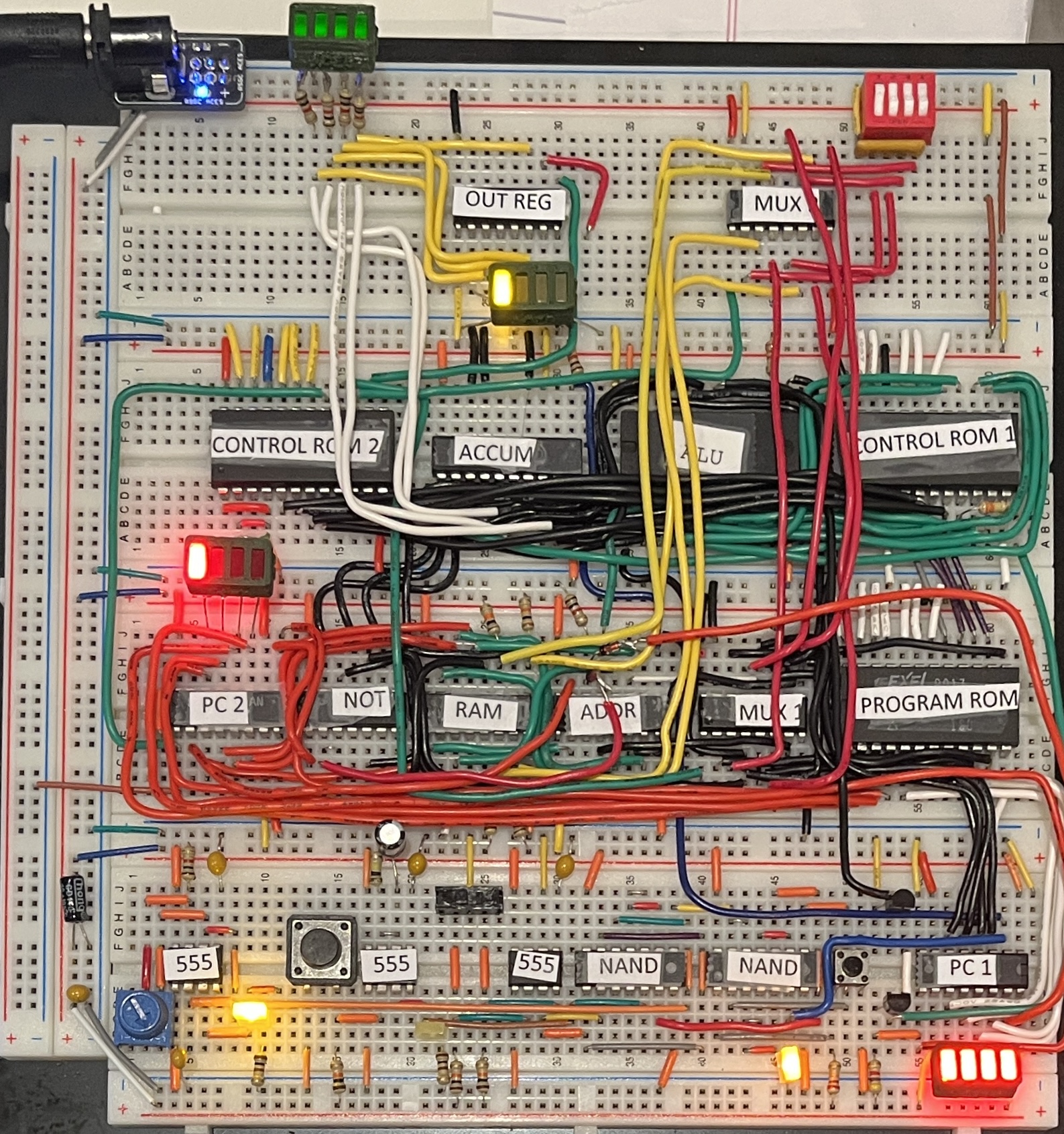
Fully integrated processor
Architecture
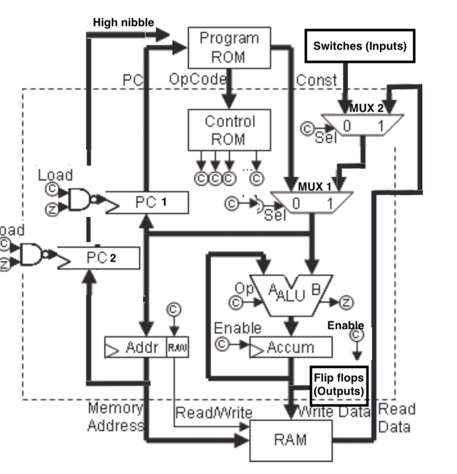
The standard CHUMP consists of several 4-bit busses and a 10-bit control bus that
connect the various components together. The program counter starts at 0 and increments on each rising
edge of the clock. The outputs of the program counter are fed directly into the program ROM
which contains an OpCode and operand for each value of the program counter. The OpCode corresponds to a series
of control bits and tells the processor which instruction to execute.
CHUMP has 3 locations that it can store values: the RAM and accumulator, which can hold data indefinitely, and
the address buffer, which can hold data for a single clock cycle. The accumulator is meant to temporarily store
values and can hold exactly one 4-bit value which is pulled directly from the output of the ALU. On any instruction
that manipulates numbers, the accumulator is enabled, which means that it takes the value from the ALU on the rising
edge of the clock cycle.
CHUMP architecture and logic diagram
Key Takeaways
Instruction sequencing and timing constraints
Debugging large digital systems without abstraction layers